
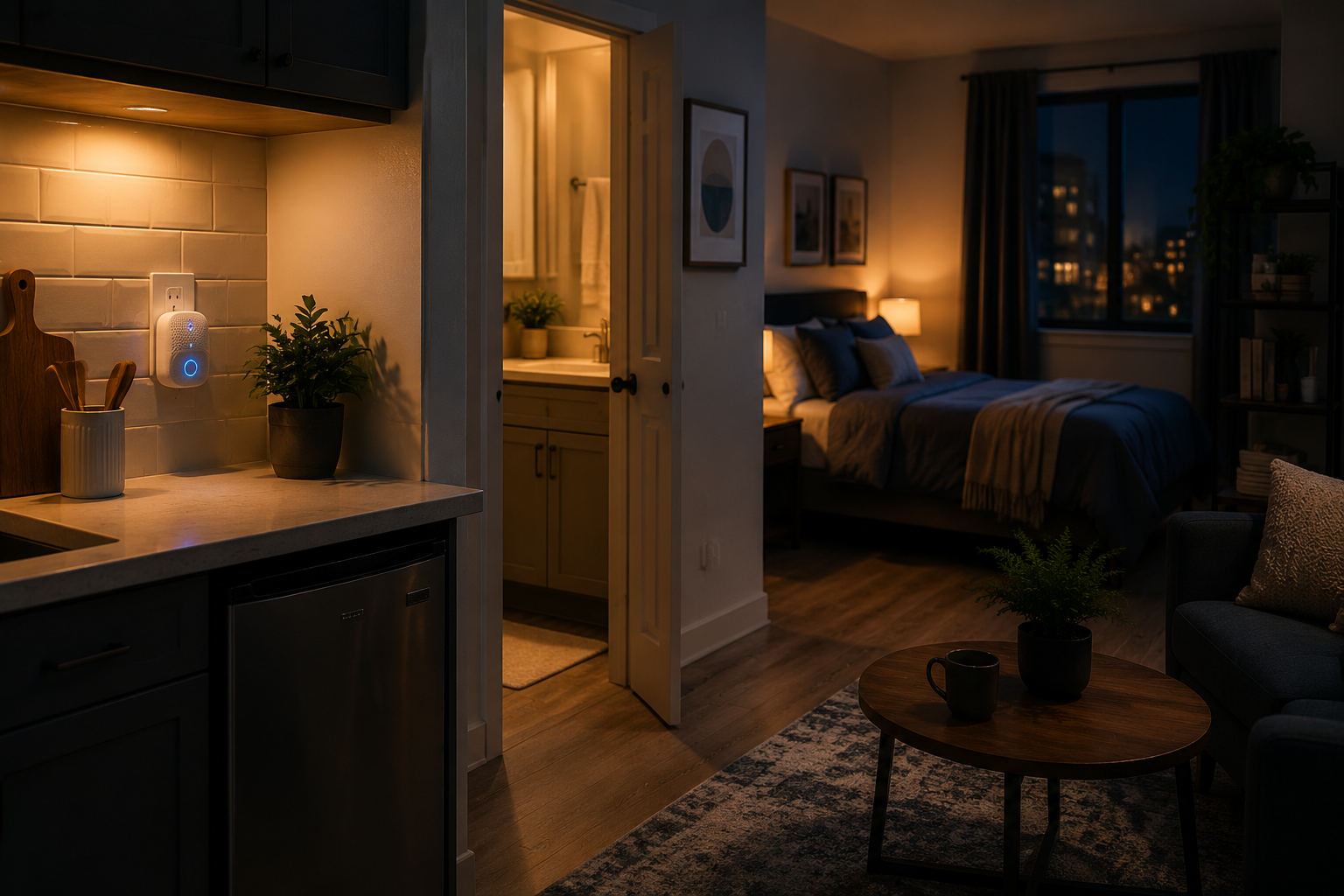
It was 2:47 a.m. on a Tuesday — I know because I checked my phone three times, hoping the scratching would stop. I live in a 400-square-foot studio apartment, which means my bed is eight feet from my refrigerator and my kitchen sink is basically my nightstand. When you hear something moving behind the fridge in a space that small, there’s no ignoring it. You can’t just close a door and pretend it’s not happening. Every sound is your sound, right there with you.
If you’re reading this, you probably know that exact feeling — the one where your stomach tightens and you suddenly realize you’re not alone in your apartment. I’d been in my studio for two years with zero pest problems. Then, out of nowhere, late-night scratching. A few days later, I found a single mouse dropping under the sink. In a studio, one dropping feels like an invasion.
Why a Studio Apartment Makes Pest Problems Feel Worse
In a larger apartment, you might have a pantry, a hallway, a separate bedroom — some mental and physical distance. In a studio, the entire living space is one open room. That means any pest issue is immediately a everywhere issue. There’s no buffer zone. A mouse that gets into the kitchen has a clear path to your bed, your clothes, your couch. And because the square footage is so small, you notice every single sign: the faint smell, the droppings, the scratching. It’s psychologically harder to deal with because you can’t escape it.
But there’s another side to this: a studio is a contained space. If you can deploy a solution that works effectively in a confined area, you might actually get faster, more noticeable results. That’s the bet I made when I decided to try PestLab.
What I Tried Before PestLab (And Why It Didn’t Work)
Before plugging anything in, I went through the standard renter playbook. First, I set out snap traps smeared with peanut butter. I caught one mouse on day three, which felt like a victory — but the scratching returned a week later. Then I used those plug-in ultrasonic repellents from a generic brand I found on Amazon. They were cheap, made a faint hissing sound, and honestly did nothing. I also tried sealing every gap I could find with steel wool and caulk, but in a pre-war building, there are gaps you’ll never see.
I even called my landlord, who sent a maintenance guy who shrugged and said, “It’s an old building, you’ll always have a few mice.” That was not acceptable. I started researching repellents that were specifically designed for small spaces, and that’s when I came across PestLab. I read a detailed review for renters that mentioned studio apartments, and I saw that they have a 90-day return guarantee, which made me feel less like I was gambling. (You can check their return policy and guarantee before you buy — it’s worth reading.)
Setting Up PestLab in a 400-Square-Foot Space
The PestLab device is compact — about the size of a small nightlight. It plugs directly into an outlet. In a studio, outlet placement is everything because you’re limited. I have one wall outlet near the kitchenette, one behind the couch, and one by the bed. The instructions say to place it in the room where you’ve seen the most activity, so I chose the kitchen outlet — the one closest to the fridge.
One thing I learned quickly: just because your studio is technically one room, that doesn’t mean sound waves (or ultrasonic waves) travel perfectly through it. The bathroom is walled off, even if it’s tiny. The closet has a door. The area behind the fridge is essentially a dead zone. According to a University of Minnesota Extension article on ultrasonic repellents, the waves are easily blocked by furniture, walls, and even thick curtains. In a studio, your bed, your bookshelf, your sofa — all of those can create acoustic shadows. So I placed the device at mid-height (using a plug extender) and made sure the front of the unit faced the open area of the room, not toward a wall or appliance.
I also read that ultrasonic devices can be safe for pets, which mattered because my sister brings her cat when she visits. The PestLab device uses a frequency that cats and dogs aren’t bothered by — but I still kept the device in the kitchen area, far from the cat’s usual nap spot, just to be safe.
The First Two Weeks: What I Noticed
I plugged in PestLab on a Saturday afternoon. For the first three days, I heard the same scratching. I almost boxed it up and sent it back. But I re-read the instructions: most users see results in 7–14 days. ultrasonic repellents don’t kill pests; they create an environment that pests find disorienting and uncomfortable, so they leave. Even the EPA notes that ultrasonic devices can be part of an integrated pest management approach, but they’re not instant.
On day five, I noticed something: the scratching was still there, but it was farther away. It sounded like it was coming from behind the wall near the bathroom, not directly behind the fridge. On day seven, I found two new droppings — but they were under the bathroom sink, not the kitchen. The location shift made me think the mouse was moving away from the kitchen, where the device was plugged in. By day ten, the scratching stopped entirely. For the next four days, I didn’t hear or see anything.
The 6-Week Mark: Where It Worked and Where It Didn’t
After six weeks, I had a clear picture. Here’s the honest breakdown:
| Area | Result | Notes |
|---|---|---|
| Kitchen / main living space | No pest activity | This is where the device was plugged in. The open area was fully covered. No droppings, no scratching for over a month. |
| Bathroom (separate room) | Occasional activity | The bathroom is walled off with a door. The ultrasonic waves can’t penetrate walls, so this area was not fully protected. I found a few droppings once in week 4. |
| Closet & enclosed storage | No activity observed | I kept the closet door open most of the time, which may have helped the waves reach. No signs of pests. |
| Behind the refrigerator | Unclear | This is a dead zone for any ultrasonic device. I can’t say for sure, but the dropping pattern suggested the mouse moved away from this area. |
So, the big takeaway: in a truly open studio with few walls, one PestLab unit can cover the main living space effectively. But if your studio has a separate bathroom, a walk-in closet, or any walled-off area, you might need a second unit. I ended up buying a second one for the bathroom, and that solved the issue completely.
Why Coverage Isn’t Just About Square Footage
PestLab advertises coverage up to 1,200 square feet. My studio is 400 square feet. So why did I need two units? Because square footage is a misleading metric when you’re talking about ultrasonic waves. Walls, doors, and large furniture all block the signal. The coverage is effective only in the line-of-sight of the device. In a studio, you might think one unit is enough because the space is small, but if you have a walled-off bathroom or a closet with a door you keep closed, those are separate zones.
This is a critical point that a lot of reviewers miss. I’ve read articles that say “one unit per room,” but in a studio, you don’t have separate rooms — you have zones. My advice: map out your apartment based on what the device can actually “see.” If there’s a wall between the device and a potential pest pathway, that pathway is unprotected. I learned this the hard way, but I’m glad I figured it out before the problem got worse.
What I’d Do Differently Next Time
If I were starting over, I’d buy two PestLab units from the start — one for the main living area and one for the bathroom. I’d also pay more attention to sealing gaps before plugging in the device. According to the comparison with professional exterminators, plug-in repellents are a preventive tool, not a cure-all. In my case, sealing the visible cracks behind the stove and adding a door sweep to the exterior door made a huge difference in eliminating entry points. The combination of physical barriers and ultrasonic repellent created a much stronger defense.
I also wouldn’t panic during the first week. The “it gets worse before it gets better” phenomenon is real — pests may become more active as they’re displaced. But by week two, you should see a clear reduction in signs. If you don’t, you might need to relocate the device or add a second unit.
FAQ: Your Top 3 Questions About PestLab in a Studio Apartment
Is one PestLab unit enough for a studio apartment?
It depends on your layout. If your studio is a single open room with no walled-off areas (like a bathroom or closet), one unit should be sufficient. But if you have a separate bathroom, a walk-in closet, or any area with a door that stays closed, that area won’t be covered because ultrasonic waves can’t travel through walls or doors. In my case, I needed a second unit for the bathroom. For most studios, I’d recommend starting with one and monitoring for 2 weeks; if you still see signs in walled-off areas, add a second unit.
Can I use PestLab if I have a pet in a small studio?
Yes, with precautions. The frequency used by PestLab is designed to be safe for cats and dogs, and it won’t harm them. However, in a small studio, your pet is in close proximity to the device. I’d recommend placing the PestLab in the area where pest activity is highest, and if your pet seems agitated or avoids that area, move the device or try a different outlet. For more details, here’s a full guide on PestLab safety for pets.
How long does it take to see results in a studio?
In my experience, you’ll likely see a shift in pest activity within 5–10 days. Pests won’t die immediately — they’ll be driven away from the covered area. The first sign is often a change in location of droppings or scratching sounds. Within 2–3 weeks, activity should noticeably decrease. If you’re dealing with a severe infestation, ultrasonic repellents alone may not be enough; you might need to combine them with other methods or consult a professional. The EPA notes that integrated pest management — using multiple approaches — is the most effective strategy.
What You Can Do Right Now
If you’re in a studio apartment and wondering whether PestLab is right for you, here’s a practical action plan you can start tonight:
- Map your zones. Draw a quick sketch of your studio. Identify every wall, door, and large piece of furniture. Circle any area that is completely walled off from the main room — that’s a zone that might need its own device.
- Inspect and seal entry points. Before you even plug in a repellent, check under the sink, behind the stove, and around pipes. Use steel wool and caulk to seal any gaps larger than the diameter of a pencil (a mouse can squeeze through a hole smaller than a dime).
- Place the device in the primary activity zone. If you’ve seen droppings or heard sounds in a specific area, plug the PestLab there first. Make sure the front of the unit faces the center of the room, not a wall.
- Wait 14 days before judging. Don’t give up after a few days. Monitor for signs and note any movement of activity. If you still see pests in a walled-off area after two weeks, consider adding a second unit.
- Keep a log. Take photos of any droppings or damage you find. This helps you track progress and also gives you evidence if you need to escalate to your landlord or a professional exterminator.
Living in a studio is a lesson in using every square inch wisely. Your pest control strategy should be no different. In my experience, PestLab was a game-changer for my tiny apartment — once I understood how to use it correctly. I hope your studio becomes as quiet and pest-free as mine is now.