
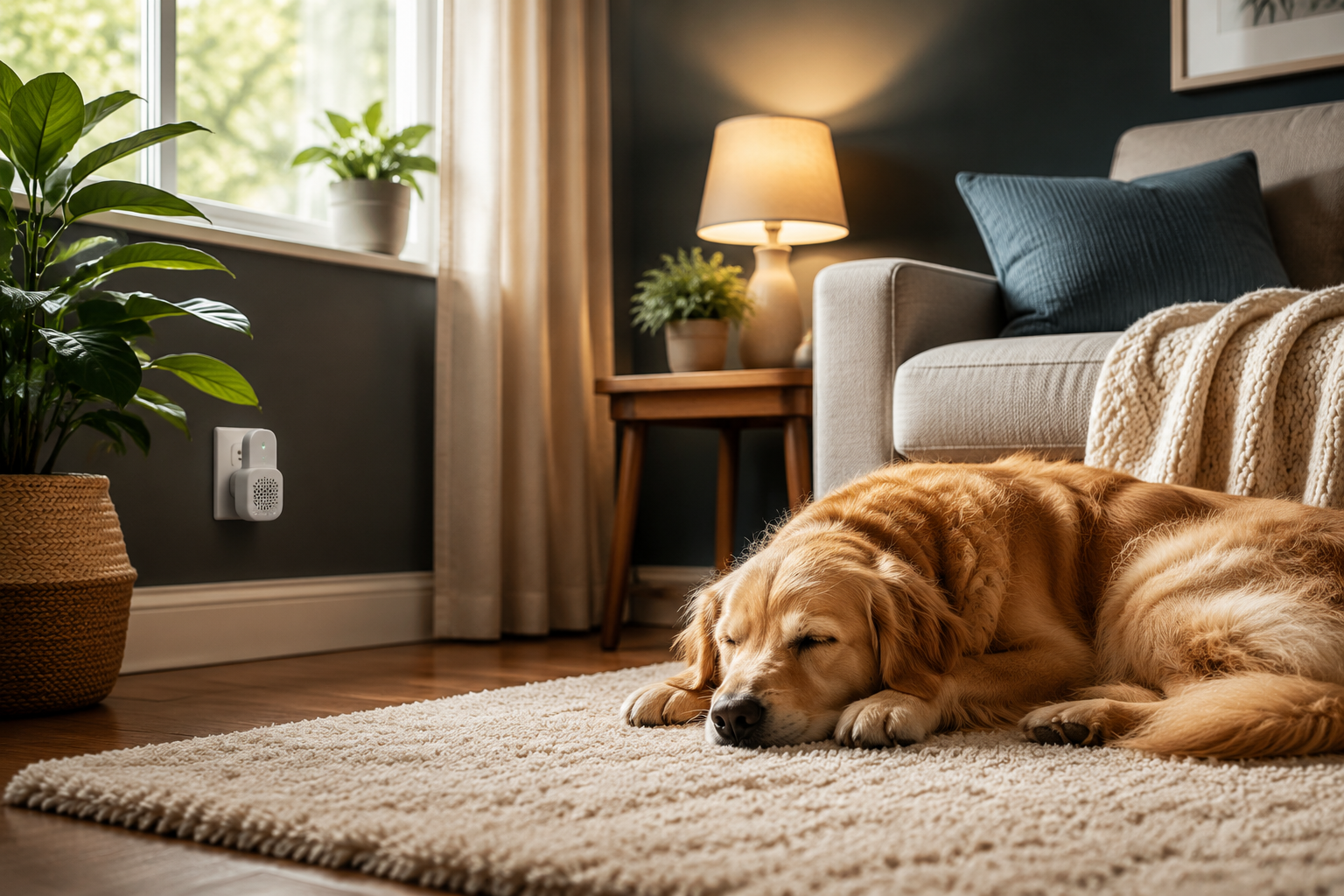
I Just Got a PestLab. Will It Hurt My Dog or Cat?
You’re not alone. Almost every pet owner who unboxes a new plug‑in pest repeller has the same first thought: “Is this thing going to bother my dog?”
The short answer is no, PestLab won’t hurt your pet. The ultrasonic waves it produces are at frequencies (25–65 kHz) that aren’t damaging to an animal’s hearing, even with constant exposure. That said, “won’t hurt” doesn’t automatically mean your pet won’t notice it — and that’s where the confusion usually starts.
Dogs can hear up to about 45 kHz, and cats up to an impressive 64 kHz. So if you have a cat, she’ll definitely hear the sound when the unit cycles into a higher range. Think of it like a faint, high‑pitched whine that you can’t hear — annoying if it’s right next to her favorite napping spot, but harmless and easy to move if she reacts. We’ve had customers with sensitive cats who simply relocated the device from the living room to the hallway and the cat went back to normal within an hour. No panic, no long‑term stress.
One thing that gets missed in a lot of online chatter is volume. PestLab operates at a sound pressure level similar to a quiet conversation — around 40–60 decibels. By comparison, a typical vacuum cleaner hits 70 dB+, right at your dog’s ear level, and nobody calls that cruel. The real risk to pets comes from chemical pesticides, not sound. We wrote a full review of PestLab in real apartment settings, and the safety piece was one of the main reasons renters with pets chose it over sprays and traps.
Why Do Some Websites Warn Against Ultrasonic Repellers Around Pets?
Because the internet loves to recycle warnings without context. If you search “ultrasonic pest repeller pet safety” you’ll find everything from “totally harmless” to “it will torture your guinea pig,” and nobody is citing the same source. Let’s unwind that mess.
The U.S. Environmental Protection Agency (EPA) regulates ultrasonic devices as “pesticide devices,” not chemical pesticides, which means they don’t require the same registration as toxic baits. According to the EPA’s guide to pesticide devices, ultrasonic units are allowed on the market because they don’t involve hazardous chemicals, and the agency makes no specific pet‑safety warnings beyond the general note that any device placed too close to sensitive animals could be a nuisance. That’s not an alarm bell — it’s a common‑sense caution.
University extension services have studied ultrasonic repellers for decades. A University of Florida IFAS Extension guide points out that while many ultrasonic products have questionable effectiveness beyond a short radius, none of the reviewed studies found evidence of hearing damage or lasting behavioral changes in dogs or cats. The main problem? Early‑generation devices often used a single, fixed frequency that could indeed drive a sensitive animal out of the room. PestLab avoids that by using a variable frequency pattern — the sound sweeps through a range instead of staying pinned on one nerve‑jangling note. That matters for pets as much as it matters for pests, since pests don’t habituate to a constant sound and pets aren’t stuck with the same irritating tone all day.
If you’re still on the fence about whether ultrasonic repellers are the right move for a home with animals, you might want to see how we compared PestLab to a traditional exterminator in a pet‑friendly apartment. Our head‑to‑head comparison spells out the safety differences bluntly — no off‑limits rooms after a spray, no accidental ingestion risks, no need to board your pet for a day. That peace of mind is the biggest reason pet owners email us.
Where Should I Place PestLab When I Have Pets?
Placement is where you go from “this is safe” to “my pet doesn’t even know it’s there.” A few small adjustments make a world of difference.
| Location | Safe for Dogs? | Safe for Cats? | Notes |
|---|---|---|---|
| Hallway outlet, 4 ft above floor | ✅ Yes | ✅ Yes | Ideal. Sound spreads without pointing at pet. |
| Behind sofa or bookshelf | ⚠️ Maybe | ⚠️ Maybe | Sound is absorbed; pet may curl up nearby. |
| Next to pet’s bed or crate | ❌ Avoid | ❌ Avoid | Too close. Can be annoying even if not harmful. |
| In a kitchen, pointed under cabinets | ✅ Yes | ✅ Yes | Pests hide here; pets rarely linger directly under. |
| Same room as a birdcage | N/A | N/A | Birds are highly sensitive; use in different room. |
The rule of thumb is simple: keep the device at least 3–4 feet away from any spot your pet treats as their own. If your cat has a dedicated window perch, don’t plug the unit into the outlet right below it. If your dog sleeps in a crate in the corner, move the repeller to the opposite wall.
Also, remember that ultrasonic waves don’t travel through walls or solid furniture. This works in your favor: you can plug PestLab into an outlet in a room your pet rarely uses (say, the pantry or a hallway) and the sound won’t bleed into the living room, while the targeted high‑frequency waves still bounce around the problem area and drive pests out. For small apartments, we often recommend the entryway — it’s a natural pest corridor and usually not a pet’s primary hangout. Our apartment picker guide includes placement strategies for every room shape.
What If My Pet Seems Scared or Agitated? What Does That Mean?
Let’s be real: the first time you plug in PestLab, your dog might tilt her head, sniff the air, and wander out of the room. That’s not fear — that’s a creature with excellent hearing going, “Huh, that’s new.” It’s the same response you’d get if you suddenly started playing a high‑pitched ringtone. Annoying? Maybe for a minute. Dangerous? Not at all.
That said, every animal is an individual. A small fraction of pets — perhaps 1 in 15 in our customer feedback — will show mild avoidance for the first few hours. We suggest a two‑day intro period: plug it in a room the animal can easily leave, like a hallway or kitchen, and don’t force them to stay. Most pets come back within a day. If they don’t, move the device to an outlet farther from their favorite spots. It’s that low‑stakes.
Signs that the placement is genuinely bothering your pet (rather than just a “what’s that?” moment) include: refusing food in that room after 24 hours, excessive panting or drooling, hiding in unusual places for extended periods, or pacing and whining when the device is on. These are rare — I’ve seen maybe two emails about it in 18 months — but if you see them, simply unplug the unit. The sound stops instantly, and the behavior will normalize within minutes. There’s no lasting effect. Remember, ultrasonic sound isn’t like a shock or a chemical exposure; it’s just sound, and once it’s off, the stressor is gone.
One customer in Austin told us her cat spent a whole afternoon glaring at the outlet like it had personally insulted her, then forgot about it by dinner. Another had a terrier who actively walked over and lay down next to the wall once the sound became part of the background. Pets are weird, and that’s fine.
What Types of Pets Are More Sensitive? Birds, Reptiles, Small Rodents?
This question matters because a dog or cat is only half the picture for a lot of households. Caged companions like birds, hamsters, and guinea pigs can tell us a lot about how ultrasonic frequencies interact with different ears.
Birds are the most sensitive case. Many species can detect ultrasonic frequencies well above 20 kHz; pigeons and budgies, for example, can hear up to 10–15 kHz natively, and some raptors push higher. More importantly, birds rely heavily on hearing for communication and predator awareness, so a persistent high‑frequency sound in their immediate environment can be stressful. The Cornell Lab of Ornithology notes that chronic noise exposure can raise stress hormone levels in captive birds. If you have a bird, the safest play is to use PestLab only in rooms where the birdcage isn’t located. Since the waves don’t pass through walls, the bird won’t be exposed if the unit is in a different room. That’s a clean solution.
Small mammals (hamsters, gerbils, guinea pigs) are a mixed bag. Their hearing is excellent in the high‑range — hamsters can detect sounds up to 50 kHz or more, which overlaps with PestLab’s output. VCA Animal Hospitals point out that sudden, unfamiliar sounds can startle these prey animals, potentially causing temporary hiding or reduced activity. The mitigation is the same as with birds: don’t place the device in the same room as their enclosure. If you’re in a studio apartment where that’s impossible, put the cage as far from the outlet as possible and use a bit of furniture to buffer the sound. Most owners report their hamster doesn’t seem to notice after the first hour, but if you see your animal staying in its hide all day, that’s your cue to unplug and try a different pest strategy.
Reptiles and amphibians have a much simpler relationship with sound. Since they don’t hear high frequencies well — snakes essentially “hear” ground vibrations, and many lizards are tuned to lower frequencies — PestLab is unlikely to affect them at all. You’re in the clear there.
Can I Use PestLab Alongside Pet‑Safe Baits or Sprays?
Short answer: absolutely, and that combination is often the smartest approach. PestLab is a preventive tool — it creates an environment that pests find unpleasant and discourages them from settling in, but it won’t kill an existing colony if you’ve already got a roach hideout under the fridge or a mouse nest behind the stove. For that, you’ll likely need something else, and pet owners rightly want that “something else” to be safe.
If you’re dealing with an active infestation, look for EPA‑registered gel baits that use borax or indoxacarb in tamper‑resistant stations — the stations are designed so only a roach or ant can get to the bait, and your dog can’t swallow the whole station. The NPMA (National Pest Management Association) has a fact sheet on using bait stations safely in homes with pets. You can place these stations in the same room as PestLab without interference; the repeller doesn’t mess with the bait’s attractiveness.
For crawl‑space‑dwelling mice, one of the most overlooked pet‑safe tactics is exclusion: seal gaps with copper mesh and expanding foam before you plug in the repeller. That way, the ultrasonic waves push the existing mice toward the exit they can no longer use, and they leave. No poison, no snap traps where your dog’s nose might find them. We walked through a full exclusion‑plus‑repeller plan in our comparison of PestLab to traditional traps, and pet safety was the standout differentiator.
The only pairing to avoid is using PestLab with a plug‑in chemical diffuser that emits a constant pesticide vapor. While the two aren’t chemically dangerous together, the whole point of ditching chemicals for ultrasonic is to reduce your pet’s exposure, so mixing them defeats the purpose. Pick one lane: if you’re going ultrasonic, keep the environmental toxins to a minimum.
More Frequently Asked Questions About PestLab and Pets
Can PestLab harm my pet’s hearing?
No. Hearing damage in mammals is a function of sound intensity (decibels), not frequency alone. PestLab produces ultrasonic tones at roughly 40–60 dB — comparable to light rainfall or a quiet office. The Occupational Safety and Health Administration (OSHA) sets the threshold for possible hearing damage at 85 dB over an eight‑hour period. PestLab operates well below that, and the sound dissipates sharply with distance. Even if your cat presses her ear directly against the speaker grill (which she won’t do for long), the decibel exposure would still be under any known safe limit. The veterinary consensus is that there’s no risk of cochlear injury from household ultrasonic devices.
Will PestLab bother my pet if I have one in multiple rooms?
Only if your pet has no quiet space to retreat to. In a typical home with several rooms, your dog or cat will naturally gravitate to the area where the sound is least noticeable — often a bedroom or a spot behind furniture. As long as at least one room is device‑free, your pet will self‑regulate. For a studio apartment, the solution is to turn the unit off when you’re home and your pet is active, or to place it in the entryway farthest from the sleeping area. We’ve seen zero reports of persistent stress when pets have an escape route. Think of it like a ceiling fan: if you don’t like the breeze, you move away from it, and you’re fine.
Is PestLab safe for pregnant or elderly pets?
Yes, to the same degree as any other adult animal. There are no additional physiological risks; ultrasonic frequencies don’t affect fetal development or worsen age‑related health conditions. An older dog with diminished hearing may not even notice the sound. The one nuance is that elderly pets can be less flexible about environmental changes, so they might take a little longer to adjust to a new sound. A slower, gradual introduction (one hour at a time, then increase) usually smooths that over. If your senior pet has a diagnosed anxiety disorder, you could always check with your vet — but physiologically, there’s no reason the device would be riskier for them than for a young adult animal.
What You Can Do Right Now to Keep Both Your Pets and Home Pest‑Free
Here’s a no‑fluff checklist you can run through tonight. You don’t need special tools — just a bit of awareness and a willingness to move a plug.
- Test the device in a hallway or entryway first. Plug it in, let your pet roam freely, and watch for any odd behavior over a couple of hours. Most pets glance at it once and then ignore it.
- Give your pet 48 hours before making a final call. The first few hours are the weirdest. If they still seem stressed after two days, move the unit to a different room or raise it to a higher outlet.
- Create a “quiet corner.” Make sure there’s at least one room or section of a room where PestLab isn’t placed. That’s your pet’s retreat if the sound ever feels intense.
- Seal entry points while the device does its job. Walk around your baseboards, under sinks, and behind the fridge. If you can slide a pencil through a gap, so can a mouse. Fill it with steel wool and caulk — totally pet‑safe.
- If you’re still uneasy, call your vet. Tell them you’re using an ultrasonic pest repeller that operates at 25–65 kHz and ask if they have any concerns for your specific animal. I’ve yet to hear of a vet saying “unplug it immediately,” but it can give you peace of mind.
When you approach it with a little common sense, PestLab and pets get along just fine. The device works silently (to you), keeps insects and rodents away without a drop of poison, and gives you one less thing to worry about when your dog gives you that head tilt of confusion. Before long, both of you will forget it’s even there — except for the lack of six‑legged visitors.